

Showing love
Have you ever sat down with a family member and had a heart-to-heart conversation? (At the moment, this seems as more likely to occur as a conversation over the phone). Some of you who have lived ‘a long life’ might also have had the experience where the family members who didn’t get on at one point have become ‘çloser’ and experienced reconciliation. Sometimes it does happen!
In my first parish some 25 years ago, I witnessed a touching scene at a graveside funeral where two family members who had not spoken in many years moved across to embrace one another and held each other weeping and then made their peace.
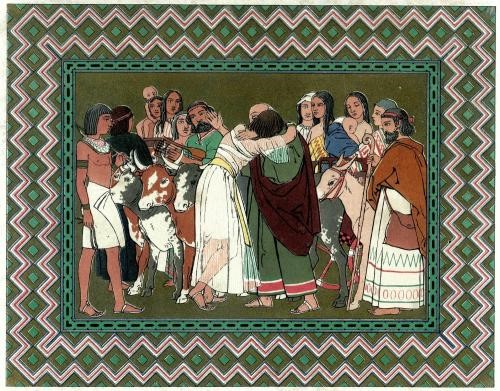
The reading from Genesis is about a family coming together again. As part of the whole Joseph saga with many twists and turns of fate for Joseph: from being thrown down a pit and being badly treated by his brothers, it appears that the tables are now turned. Joseph is in a position of power and influence and he chooses to show mercy (though this was not first choice). It is helpful in this story in some ways to know that the journey to showing mercy and forgiveness has taken many years. So, for many of us in our relationships it would be unusual and perhaps not appropriate to rush forgiveness without giving some time to heal and acknowledge any wrongdoing. Yet in the Scriptures Joseph is seen as able to offer mercy because God has purposed his life to be a life-bringer. In this sense Joseph foreshadows the life of Jesus the Christ and all who seek to imitate the purposes of God to be agents of life and love.
If we look in more detail at what happens in the story, we can observe some tender moments. First Joseph speaks to his brother Benjamin in Hebrew to reveal his identity, declaring his name, weeping, and asks the brothers to move closer.
In this we might say that there is a boundary crossed in space, and in relationship, remembering that Joseph in this part of the story is a government official in Egypt. Then Joseph tells of his life and moves to embrace Benjamin and then to kiss all his brothers (an intimate greeting). The kiss (in this setting) can be understood as an important sign of forgiveness and reconciliation. We are given to understand that Joseph views his survival story (and perhaps this moment) and all that has led to it as part of God’s plan for them.
How do you make sense of your family stories with all the dramas and highs and lows? Is there a truism that somehow there is a thread of blessing amidst your own life, where there might have been a breakdown in relationships and then later some form of wisdom gained or even reconciliation? The more I listen to family stories the more I see that there are common human experiences and patterns, where some family members showed kindness, some have felt marginalised and even vanished off the scene, some have been included and some excluded for a whole manner of reasons. We are making meaning in our human stories and for those of us with a faith perspective seeking to name God in our experience. And the metaphor of the family of God includes more than just our kinfolk.
The story of Joseph showing mercy and the story of the Canaanite women seeking mercy and healing from Jesus can invite us to see where we can make choices to look beyond our immediate responses to ask, ‘What is our faithful response to the people we encounter?’ in our families and to those who are the outsiders like the Canaanite women in the gospel story. We can be agents of life and love and we can choose to harm. From today’s readings I invite you to consider the ethic of love as something to aspire to, where we seek to do unto others what we would like to be done toward us.
Amen.
Lynette Dungan